Call to mind a time that you felt a huge rush of will to do something, to make something happen. Maybe it was an idea for a project, or even just a resolution to change your diet or habits.
How strong and resolute was it in the moment? And how long did that will last for?
Our culture often treats motivation as a binary state – it’s there, and usually semi-permanent or it’s not. Conventional wisdom is that either your tactics are working, so the employee is motivated all the time because of it, or they are not working and so they are unmotivated.
But compare that to your experience. Are you defined by the presence of that will at one moment, or the absence of it later? Is your state of will more complex than that?
Take a moment to reflect, what was the source of that will in you?
Finally, what instruments did you, or do you use for bringing that will back after it disappeared?
The degree of will is one of the most key determining factors for the success of any endeavour. It makes the difference between employees who steward a company’s resources carefully and use spare time to innovate and pursue new creative opportunities that further the mission; and employees who take as much as they can and give as little as they can back, and skive the moment the boss’ back is turned. It’s not hard to see that modern management is far from achieving their promise of a motivated workforce here, and so many organisational problems really have its roots in this ‘Will Gap’.
While businesses can get by with reasonable success with some of modern management’s current best practices when times are good, there are key moments in a business’ lifetime when the limitations of these approaches are laid bare, like in times of crisis when the manager slams their foot down on the accelerator, and there’s no just response. These moments can be when a competitor opens up nearby, when there are supply chain disruptions, or when a large client is lost. The most hazardous moment for any organisation though is the hazard of new generation – when the will that is carrying an organisation forward has to be passed on, for example, when a founder or charismatic leader needs to step back, ‘pass the baton’ and let a new generation of leaders and staff in the organisation carry on the effort, the continuation of which cannot tolerate much Will Gap between the new and the old.
None of this will be news to most people. The reason we aren’t focusing on will more intensively is not that we don’t value it, but that our current common sense approaches aren’t particularly effective, and so we need to be working on other things that we think will have more of an effect. Is there a different way? In order to determine this, we need to examine the current approaches to will that we can find. Below is an ordering framework that I call Levels of Approach to Will:
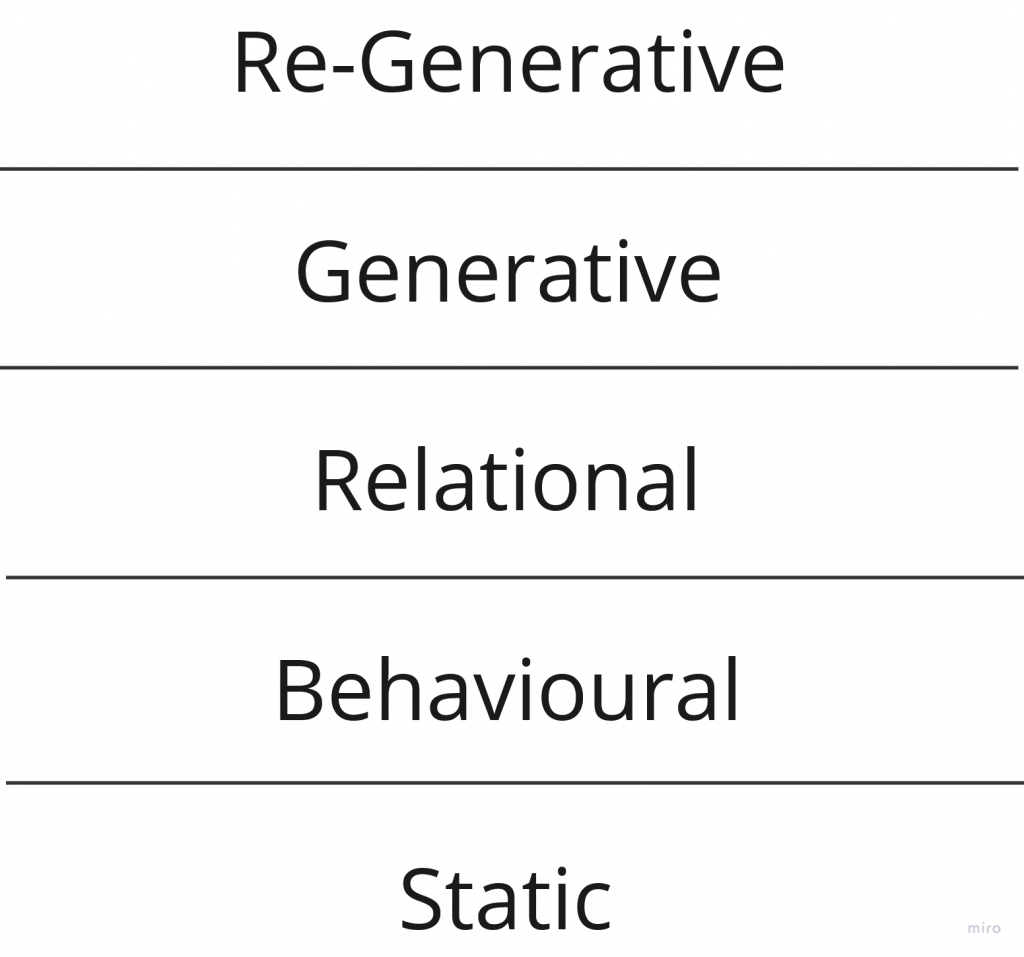
To explain, we’ll start at the bottom and work our way up. It’s important to say that it’s not that one level is more right than the other, it’s about orders of effectiveness, and often, the higher orders include and transcend the lower rather than negate them.
Static is the assumption that motivation or will is innate, something you’re born with. Either you’re self-motivated, or you’re not. There’s little or nothing that can be done about it. This approach leads to, at worst, eugenecist thinking, or at best, the firing and hiring of employees based on whether they are ‘the right sort’ with no room for development or change provided.
Behavioural responds to the Static Will level by saying that will can be influenced, so there is a reason to try, but the assumption that there is no internal agent of will means humans can only respond to external sources of will – the carrot (incentives, rewards) or the stick (punishments, feedback). The assumption is that humans are animals, and therefore their will should be approached like that of an animal. The problem is that when you treat a human like an animal, that’s what they become, and you lose the human that you employed. This is the most pervasive level in current business management.
Relational responds to the Carrot & Stick method by trying to treat humans as humans, and of all equal value. It posits that the will you feel is determined by your relationship to an entity: if humans feel in a relationship that has qualities of respect, value, inclusion or ownership, then they will have will. If they feel excluded, undervalued, and cut out of the process, then they will not. Outside of this parameter, though, nothing else really matters.
This encompasses the notions of ‘skin in the game’, worker’s co-ops, and democratic and participative governance models – all seek to change the relationship in order to affect will. However, it’s also a flat model, as humans and their democratic instincts are placed on a pedestal, excluding anything ‘bigger than us’ like life itself, nature or spirit. It’s the most popular ‘progressive’ response to Carrot & Stick. Though, with many years under our belt, promoters of this level are unable to explain why upending relational structures hasn’t produced the results they promised.
Generative embraces that will is an internal condition that can be generated independently of external conditions like relationship, incentives and threat of punishment. However, this impulse still often comes from the outside at this level, be it a motivational speech from a charismatic leader or an inspirational story. This level is driven by the ‘roles in wholes’ effect: the generation of will that arises from seeing a role in something bigger than oneself. Looking at it from the other direction, this is also the feeling of being ‘moved’ by something (or a Will) bigger than yourself.
This is the effect that mission- or purpose-driven approaches aspire to. But crucially, why mission statements don’t work is what is actually driving the Generative order is not consequences (positive or negative) or relationship like the other orders, but understanding. What these approaches have in common is that they help people feel like they understand the world around them, and to understand a role they can play (“roles in wholes”). A common example of this we see a lot of these days is a simple populist story that immigrants are causing the ills around us and that you have a role to play as a defender of white Christendom.
If populists are working at the generative level, where are those trying to counter this story working? What does this tell us about what is required for success?
However, a key quality of understanding, and the will that derives from it, is something that we explored right at the beginning is that it is an ethereal, temporary phenomenon. No matter how much money you spent on that motivational speaker, the effect doesn’t last forever. Have you ever experienced a time when you felt like you saw or understood something so clearly – perhaps that all the world are brothers and sisters and the universe is just love and light – only for this realisation to feel ‘gone’ again a few days later?
Understanding is a state of mind that is easy-come, easy-go. What feels like the most incredible mission statement one day, is just some words printed on a page the next, and that’s why the half life on these statements is so short. And with loss of understanding disappears the will too.
In order to continue to feel will, we need to take the effort to recall and regrow the state of mind of understanding and will that we found ourselves in (perhaps when the mission statement did feel alive). For many companies, this means that there is a brief buzz and, ignoring this need and assuming that the mission statement on the wall is all that is needed, they then collapse back into business as usual.
On the other hand, for leaders who do this well but unconsciously, this can actually become the biggest burden: that your team rely on you to continually generate their will, leading to resentment and burnout.
Is there another way?
Re-Generative, or Regenerative, approaches instead create the conditions for someone to consciously re-generate that state of understanding and will in themselves when the moment inevitably passes. Some people, those we often call ‘self-motivated’ and are often successful in their endeavours, naturally develop the capacities to re-generate their own will. However, being unconscious of quite how they do that, their will can still be intermittent, and superficial without knowledge of how to deepen it further. Paradoxically, they are also susceptible to work in lower order ways with others (“I’m just motivated, so others could just be more motivated too”). We also just examined how when they work in Generative ways, they continually try to use their will to activate will into others, leaving them burned out. In both cases, when the person moves on because the founder or retires or the charismatic leader gets sick, the activating pump of will disappears with them, and the organisation begins to die. Recognising this, many work themselves to the grave, unable to let go until their body does.
The flip side is that by consciously creating the conditions for the re-generation of will for themselves and for their team, they are able to do so more reliably, to deepen the will even further, and to know how they can approach others in a way that enables the generation of will to continue beyond them. This enables teams to be truly autonomous and effective, and for founders and leaders to play a different, higher order role than the prime motivator.
Everything has a downside, though, so what could possibly be the downside of this level? When you work at the Regenerative level, you grow the locus of control of the will in the person themselves, rather than source it from the external world. This means you lose ‘control’ of that will, and what that person will do with it. Even though it really was just a facade of control, the idea that we influence or control the will of others towards our own ends (e.g. the success of our business) is an idea many take enormous comfort in. When we work at the Regenerative level, we need to overcome our discomfort at the idea of not being in control and trust that, when we hand over ‘control’, the person will still want to work with us. This lack of trust is the number one barrier to working at this level. And by holding tightly to the idea that we cannot trust the will of others, we limit the order of approaches that we are able to reach, and so, condemn ourselves, like Sisyphys, to roll a boulder to the top of the hill, only for it to roll to the bottom again.
The other downside is the loss of the myth of a ‘self-motivated’ person. The reality is that, while locus of control is placed squarely in the person, the Regenerative Level is a co-created level. The aforementioned conditions required to regenerate will necessarily includes others, though it doesn’t rely on them in the same way that the other levels do. But when I share responsibility for the sourcing of my will, my successes are no longer entirely my own either. Another aspect to consider here is that this level of will is like the murmuration of starlings who move as one through the sky – many wills, through an understanding of a shared whole (the murmuration, the organisation), moving together as one. Each has total free will, but exercised in the context of the murmuration, a whole Will is created beyond the sum of its parts. In this mode, who is responsible for the murmuration?
If we can reconcile with our discomfort, however, what becomes possible? Can you envisage what you could achieve if you could trust your team to take as much care for the company as you do? When you don’t have to spend your time cajoling or figuring out the next incentive?
Where are you in this framework? Which level do you source your will from? Where do you work with others?
This is only scratching the surface on Will. If you’d like to know more, reach out.